In 50 words: Global storage cell shipments reached 467.84 GWh in H1 2026, up 94.8 percent, while EV sales rose 2 percent. Storage passed automotive in Chinese battery output for the first time, non-China demand crossed 56 percent of the total, and a 2 percent Chinese consumption tax took effect on 1 September.
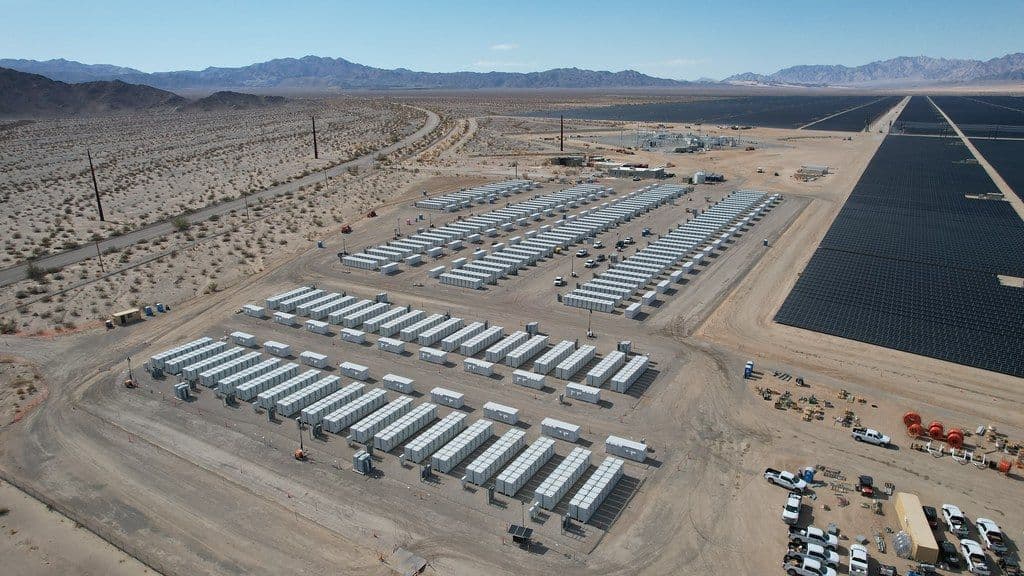
For fifteen years the battery industry was an automotive industry with a stationary storage side business. In the first half of 2026 that relationship inverted. Global energy storage cell shipments reached 467.84 GWh, a 94.8 percent increase year on year, against global EV sales of 9.6 million vehicles — up just 2 percent. In August, storage cells accounted for more than 40 percent of China's total lithium battery production, overtaking automotive batteries for the first time.
This is not a good quarter. It is a change in what the industry is for, and it arrived in the same month that Beijing removed an eleven-year tax exemption on the product. Both things matter to anyone buying batteries in 2027.
1. What the H1 2026 data actually shows
The headline figures, from InfoLink Consulting's half-year shipment tracking:
| Metric | H1 2026 | Change |
|---|---|---|
| Global storage cell shipments | 467.84 GWh | up 94.8 percent year on year |
| Full-year 2026 forecast | 1,026 GWh | up about 67.5 percent on 612.39 GWh in 2025 |
| Shipments outside China | 258.7 GWh | 56 percent of global, first time above half |
| Global EV sales (comparison) | 9.6 million units | up 2 percent |
| CATL share of ESS battery market | 27.1 percent | market leader |
Chinese storage manufacturers signed a record 817 GWh of new orders in the first half alone — a forward order book larger than the entire global shipment volume for 2025.
Set against deployment forecasts, the picture is consistent rather than speculative. BloombergNEF projects 158 GW and 459 GWh of global storage deployments in 2026, a 41 percent increase on the record 112 GW installed in 2025, with annual additions nearly doubling over the following decade to reach 308 GW by 2036 and cumulative capacity of 2.9 TW and 10.5 TWh.
The reason this matters more than a growth statistic is what it does to manufacturers' incentives. When storage was the smaller line, cell producers designed for automotive duty cycles and sold surplus capacity into stationary applications. When storage is the larger line, the product roadmap follows storage requirements: longer cycle life, larger format cells, lower cost per cycle rather than per kilogram, and far less concern about energy density and packaging volume. That reorientation is already visible in the shift toward 300-Ah-class and larger cells, and it will compound.
2. The demand base moved outside China
The second structural shift is geographic. Shipments to North America, Europe and other markets reached 258.7 GWh in H1 2026 — 56 percent of the global total, overtaking China for the first time.
For most of the last decade the Chinese domestic market was the demand engine and everywhere else was an export opportunity. The inversion has practical consequences. Chinese cell makers now face a customer base that is majority non-domestic, which raises the commercial importance of international certification regimes, local content rules, warranty structures enforceable in foreign jurisdictions, and fire-safety standards written by American and European authorities. It also means Chinese producers have a direct exposure to trade policy in markets they do not control — and, as the tax change below shows, a domestic policy environment that no longer treats their output as an infant industry deserving protection.
3. China's 2 percent consumption tax
Effective 1 September 2026, China restored a consumption tax on lithium-ion batteries after an eleven-year exemption. The details matter more than the headline rate:
- Rate: 2 percent from 1 September 2026, rising to 4 percent from 1 September 2027.
- Scope: lithium-ion cells, battery packs, and battery clusters assembled from cells.
- Not in scope: complete battery energy storage systems that incorporate electrical equipment, thermal management and control systems. These are classified as power equipment and escape the additional consumption tax.
- Exports: directly exported batteries remain exempt, and manufacturers can claim refunds on eligible tax paid on purchased batteries.
- Exemptions to end-2028: sodium-ion batteries, solid-state batteries and fuel cells. Semi-solid batteries do not qualify as solid-state.
A parallel change affects solar cells from April 2027, which tells you this is a coordinated withdrawal of tax preference from mature clean-energy manufacturing rather than a measure aimed at batteries specifically.
The classification boundary is the commercially interesting part. A cell is taxed; a finished system is not. That gives Chinese suppliers a clear structural incentive to sell integrated systems rather than bare cells, which accelerates a move up the value chain that was already underway for margin reasons. Buyers who have built their procurement strategy around purchasing cells and integrating locally should expect the price differential between cells and complete systems to narrow.
Manufacturers moved immediately. EVE Energy and Lishen Battery began applying the additional 2 percent to deliveries from 1 September.
4. The sodium-ion carve-out is industrial policy
Exempting sodium-ion and solid-state batteries through the end of 2028 while taxing lithium-ion is not a rounding detail. It is an explicit statement that Beijing considers lithium-ion a mature technology that no longer needs support, and sodium-ion and solid-state to be emerging technologies that do.
For sodium-ion the timing is significant. The technology has struggled to compete on cost with LFP precisely because LFP kept getting cheaper, and its structural advantages — abundant raw materials, better cold-weather performance, no lithium price exposure — have not been enough to overcome a persistent cost gap. A tax differential of 2 percent now and 4 percent from September 2027, applied to the competing chemistry rather than as a subsidy to sodium, narrows that gap without costing the exchequer anything. It is a cheap and well-aimed intervention, and grid storage is the application where sodium-ion's weight and volume penalties matter least.
The explicit exclusion of semi-solid batteries from the solid-state exemption is worth noting for anyone evaluating supplier claims. Several manufacturers market semi-solid products using solid-state language. The tax authority has now drawn a line that the marketing had blurred.
5. What it does to cell prices
Less than the headline suggests, on its own.
One published estimate puts the 2 percent rate at roughly CNY 0.00648 per Wh, in the region of one US dollar per kWh. Against Chinese domestic 314-Ah LFP storage cells averaging about 0.365 yuan per Wh in August 2026 — approximately 72 dollars per kWh — that is a low-single-digit percentage effect, and analysts have characterised the system-level storage cost impact as manageable.
The relevant price context for international buyers is that large-scale Chinese procurement has established low-end benchmarks near 47 dollars per kWh for LFP cells, with international tender results clustering in a 55 to 75 dollars per kWh range depending on volume, delivery terms and counterparty. A one-dollar tax effect does not move a market with that spread.
What does move it is the interaction of three forces pulling in different directions:
- Downward: massive capacity expansion and an order book of 817 GWh signed in six months, in an industry that has consistently priced to fill fabs.
- Upward: the consumption tax at 2 percent now and 4 percent from September 2027, plus genuine demand tightness as storage becomes the primary demand driver rather than the residual buyer of automotive capacity.
- Volatile: the tax scope boundary, which changes the relative price of cells versus systems and gives suppliers a reason to re-cut their quotations.
The practical forecast is not a price rise. It is the end of the reliable, monotonic decline that buyers have planned around since 2023. Stronger suppliers are better positioned to pass the cost downstream, which means the tax will show up unevenly across the supplier base rather than as a uniform step change.
6. What it means for BESS buyers
Four concrete implications for anyone procuring storage in the next eighteen months.
Check what your contract actually prices. If you buy cells and integrate, you are inside the taxed category and exposed to the September 2027 step to 4 percent. If you buy complete systems, you are not directly exposed, though your supplier's cost base may be.
Get the 2027 escalation into the contract now. The rate doubles on 1 September 2027. Any supply agreement spanning that date should say explicitly who absorbs the increase. This is the single highest-value clause to negotiate this year, and it is easy to miss because the current rate is small enough to ignore.
Treat direct exports carefully. Directly exported batteries remain exempt. Whether your specific supply chain qualifies depends on the routing and the entity structure, not on where the cells were made. Ask the question in writing.
Stop extrapolating the price curve. Procurement models that assume continued steady annual cell price declines through 2028 are now working against an explicit policy headwind and a demand base that no longer has automotive slack to absorb. Build a flat case and a modest-increase case alongside the declining one.
7. The India angle
India is one of the markets absorbing that 56 percent non-China share, and its storage procurement has repriced faster than almost anywhere.
Standalone BESS tariffs collapsed from a single pilot round at Rs 10.83 lakh per MW per month in 2022 to a record low of Rs 1.48 lakh per MW per month discovered in late 2025 — a decline of roughly 86 percent in under three years — with recent state auctions settling around Rs 1.8 to 2.3 lakh per MW per month. Those tariffs were bid into an environment of continuously falling imported cell prices, and viability gap funding did part of the work.
Two consequences follow. Projects already bid at aggressive tariffs but not yet supplied carry real exposure if the cell price curve flattens rather than continues falling, because the bid assumed a procurement cost that may no longer be available. And the case for domestic cell manufacturing under India's production-linked incentive programme improves at the margin — not dramatically, but a Chinese tax on the competing supply is directionally helpful to anyone building capacity in India, and the effect doubles in September 2027.
8. Frequently asked questions
Did storage really overtake EV batteries globally?
Within Chinese production, yes — storage cells passed 40 percent of China's lithium battery output in August 2026, overtaking automotive for the first time. Globally, EV batteries remain a large category; the decisive change is in growth rate, with storage shipments up 94.8 percent against 2 percent growth in EV sales.
Does the Chinese tax apply to complete battery storage systems?
No. Complete systems incorporating electrical equipment, thermal management and controls are classified as power equipment and avoid the additional consumption tax. The tax applies to cells, packs and clusters.
Will this raise BESS project costs?
Marginally and unevenly. At roughly one dollar per kWh against cells transacting in the 47 to 75 dollars per kWh range, the direct effect is small. The more consequential change is that the reliable downward price trend buyers have planned around is no longer dependable.
Are sodium-ion batteries now cheaper than LFP?
Not in absolute terms. The exemption narrows the gap rather than closing it, and it widens in sodium's favour when the lithium rate doubles in September 2027. Grid storage is where sodium-ion's disadvantages matter least, so that is where the effect will show first.
What happens in September 2027?
The rate on lithium-ion cells, packs and clusters rises from 2 to 4 percent. Sodium-ion, solid-state and fuel cells remain exempt through the end of 2028.
Does this affect batteries already exported from China?
Directly exported batteries remain exempt from the consumption tax, and manufacturers can claim refunds on eligible tax paid on purchased batteries. Whether a particular supply arrangement qualifies depends on its structure.
9. What to watch next
Three markers. The September 2027 step to 4 percent is the real test — it is large enough that suppliers cannot quietly absorb it, and contract language written this year determines who pays. Sodium-ion order announcements over the next four quarters will show whether the tax differential is sufficient to move procurement or merely improves a pitch deck. And the cell-versus-system price spread is the number to track monthly, because the tax boundary gives Chinese suppliers a structural reason to compress it, which would reshape how integrators outside China build their business.
Note: Shipment figures are from InfoLink Consulting as reported in August 2026; tax provisions are as announced by China's Ministry of Finance effective 1 September 2026. Cell prices are market benchmarks that vary by volume and delivery terms, and tax treatment of a specific supply arrangement should be confirmed with a qualified adviser. See our editorial standards and AI disclosure. Related reading: battery cell pricing tracker, LFP vs sodium-ion, how to choose a BESS, India energy storage policy. Explore battery storage and policy and tenders.
Sources
- pv magazine — Energy storage cell shipment data for H1 2026 reveal three structural shifts
- ESS News — Energy storage cell shipment data for H1 2026 reveal three structural shifts
- pv magazine — China restores 2% lithium-ion battery tax after 11-year exemption
- CnEVPost — China to impose consumption tax on lithium batteries, exempting sodium-ion and solid-state cells
- CnEVPost — Global ESS battery market share in H1 2026
- PV Tech — China to end tax breaks on certain PV cells, battery products
- Energy-Storage.News — BloombergNEF forecasts 158GW of global energy storage deployments in 2026
- Benchmark Mineral Intelligence — China's finance ministry announces end to domestic lithium-ion tax exemption
- IEEFA — Viability of standalone battery energy storage tariffs discovered in 2025
Researched and drafted by the Earth Energy Log Editorial Desk with AI assistance. Reviewed by Pruthvi A. before publication.
How we work: Editorial standards · AI disclosure · Report an error